
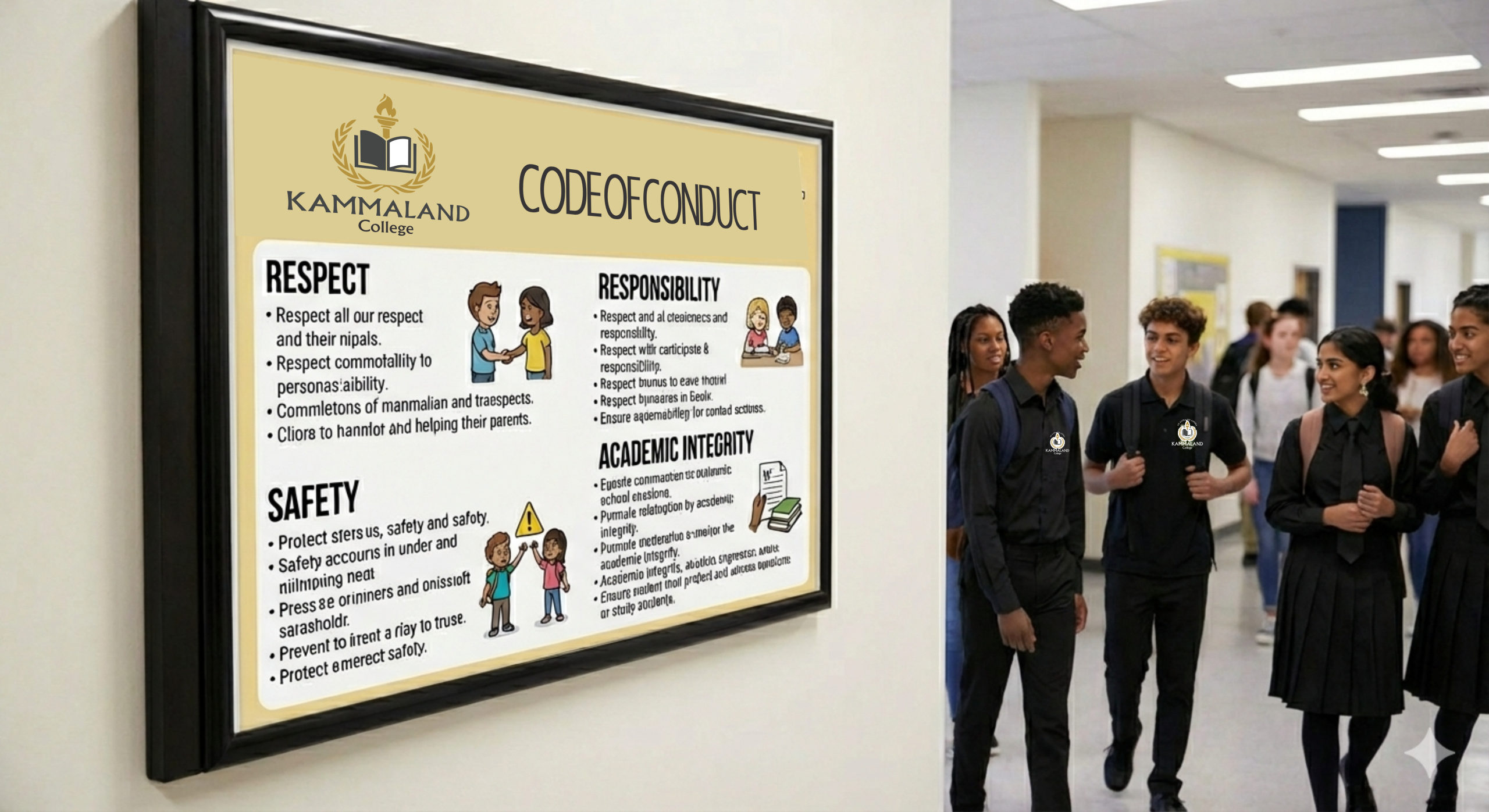
Kammaland High School code of conduct
Adopted: 2025
Reviewed annually by the School Governing Body
1. Our Mission and Vision
At Kammaland High School, our mission is to empower learners to thrive academically, socially, and
emotionally in a safe and respectful environment. We are committed to developing young adults who
are responsible, resilient, and respectful members of society.
2. Introduction
This Code of Conduct serves as a framework to guide learner behaviour in alignment with the values
of Kammaland High School. It applies at school, during school activities, in uniform, and whenever
learners are associated with the school. Parents and guardians, by enrolling their children, commit
to supporting this Code in full.
3. Core Values and Expectations
Kammaland High School expects learners to:
- Attend school and classes regularly and on time.
- Wear the correct uniform neatly and with pride.
- Treat everyone with respect, kindness, and courtesy.
- Care for school property and respect the belongings of others.
- Follow all school rules and teacher instructions.
- Strive for excellence in academics, sport, culture, and conduct.
- Promote a welcoming, inclusive, and safe environment.
4. Appearance & Uniform
Learners are expected to wear the prescribed uniform neatly and correctly. Refer to Addendum A.
Hairstyles, jewellery, and accessories must align with school rules. Civvies days require neat,
modest clothing that reflects
the good name of the school.
5. Behaviour & Conduct
Learners must behave respectfully towards staff, peers, and visitors at all times. Bullying,
harassment, discrimination, fighting, and defiance are strictly prohibited. Learners are
representatives of the school both on and off school premises, including online.
6. Bullying & Harassment
Kammaland High has a zero-tolerance policy on bullying. This includes physical, verbal, social, and
cyberbullying. Learners must report incidents immediately. Support will be provided to victims, and
perpetrators will face disciplinary action. Refer to Addendum C.
7. Attendance & Punctuality
Attendance is compulsory. Absences require written explanation from parents/guardians. Learners
must be punctual. Frequent lateness will result in disciplinary measures.
8. Academic Integrity
Cheating, plagiarism, and dishonesty in assessments are serious offences. Consequences may include suspension, loss of marks, or disciplinary hearings.
9. Property & School Grounds
Respect for school property is expected. Theft, vandalism, graffiti, or misuse of resources will
result in severe consequences. Learners are expected to keep the environment clean and litter-free.
10. Substance-Free School
The possession, use, or distribution of drugs, alcohol, tobacco products, or vaping devices is
strictly forbidden on school premises, during school-related activities, or while representing the
school in any capacity.
Learners found in violation of this rule will be regarded as committing a serious offence and will
be subject to:
- Immediate confiscation of the substance or device.
- A disciplinary hearing, which may result in suspension or expulsion.
- Possible reporting to law enforcement authorities in line with South African legislation.
The school has a duty to ensure a safe and healthy learning environment. Any behavior that
compromises the safety, health, or reputation of learners and the school community will not be
tolerated.
Kammaland High School also reserves the right to conduct random searches and testing where there is
reasonable suspicion of drug or substance use, in accordance with national regulations and the
South African Schools Act.
11. Safety & Security
Learners must always prioritize safety – of themselves, their peers, staff members, and the wider
school community.
- The possession, use, or distribution of dangerous items (including firearms, knives, sharp
- objects, fireworks, explosives, pepper spray, tasers, or any weapon—real or replica) is strictly
- prohibited.
- Bringing replicas or toy weapons to school is also forbidden, as these can cause alarm and
- compromise safety.
- Any learner found in possession of a dangerous item will face a disciplinary hearing, which may
- result in suspension, expulsion, and referral to law enforcement.
- Learners are expected to conduct themselves responsibly during all school activities, outings,
- and sports events. Behaviour that endangers the safety or dignity of others will not be tolerated.
- Emergency drills (such as fire, evacuation, or lockdown drills) are compulsory for all learners
- and staff. These drills must be treated with seriousness and respect, as they prepare the school
- community for real emergencies.
- Interfering with safety equipment (e.g., fire extinguishers, alarms, first-aid kits) is
- considered a serious offence.
- Learners must report any threats, unsafe behaviour, or suspicious items immediately to a teacher, school management, or the Safety Officer.
Kammaland High School is committed to providing a safe environment for teaching and learning.
Learners who compromise the safety of others will be dealt with firmly, in line with the school’s
Code of Conduct and the South African Schools Act.
12. Digital Conduct
Online behaviour should reflect school values. Cyberbullying, posting inappropriate material, or
bringing the
school’s name into disrepute online will not be tolerated. Refer to Addendum D.
13. Participation in School Life
Learners are encouraged to take part in sport, culture, and service activities. Commitment to teams
and groups is expected once enrolled.
14. Parents and Guardians
Parents are partners in education. They are expected to support the school in upholding this Code,
encourage discipline, and ensure learners are prepared for school each day.
15. Disciplinary Procedures
Consequences for misconduct may include warnings, reflection sessions, suspension, disciplinary
hearings, or expulsion depending on severity. Restorative practices may be applied where possible.
16. Rights & Responsibilities
Learners have the right to feel safe, respected, and supported. With these rights come
responsibilities: to respect others, uphold the Code, and contribute positively to the school
community.
17. Religious and Cultural Accommodation
The school respects religious and cultural practices that do not conflict with South African law.
Written applications may be made to the Principal for exemptions.
Addendum A: Uniform Regulations
Summer Terms (First and Fourth Term):
Girls:
- School blazer
- White short sleeved shirt with school badge on pocket (tucked in)
- School tie
- Black school skirt, non-pleated (which may not be shorter than 4 fingers above the knee)
- White school socks
- Polished black shoes Boys:
- School blazer
- White short sleeved shirt with school badge on pocket (tucked in)
- School tie
- Grey school pants
- Grey socks
- Polished black shoes
Winter Terms (Second and Third Term):
Girls:
- • Full school uniform with a white long-sleeved shirt and grey knee-high socks, in addition to the above school uniform.
- Optional – Full school tracksuit. No mixing of the school tracksuit is allowed. Girls may also wear shear black stockings instead of knee-high grey socks, these may not be worn with grey socks under or over and must not be worn if laddered or torn.
Boys:
- Full school uniform with a white long-sleeved shirt in addition to the above school uniform.
- Optional – Full school tracksuit. No mixing of the school tracksuit is allowed.
Sports uniform:
Both boys and girls:
- Black Kammaland Shirt
- Black Sport shorts (for religious purposes, ¾ pants will be permitted)
- White socks (unless told otherwise by the coach)
- White sport takkies
- Beige, wide brimmed hat
- During winter terms (Third and Fourth), full school tracksuit with sport shirt and takkies may be worn during sport.
Girls:
- Black one-piece swimming costume may be worn with short black tights over. Boys:
- Black swimming pants/trunks
Both Girls and Boys:
- Black swimming cap School Function:
Both Girls and Boys:
Winter uniforms should be worn at all school formal functions. These include, but are not limited
to:
- Going to other schools to attend their functions
- Attending plays/sport while in the audience
- Prizegiving functions
Our official school tracksuit may only be ordered directly from the school’s approved supplier.
Please note that it is strictly prohibited and unlawful to reproduce or use the school badge to
manufacture tracksuits or any other clothing through unauthorized suppliers.
All other items of the school uniform may be purchased from our local stores.
Girls’ Hair Regulations
- Hair must always be clean, neat, and tidy.
- Fringes may not touch the eyebrows. If too long, they must be pinned away.
- Hair extensions may only be worn by learners in Grade 11 and Grade 12. This is considered a
- privilege, not a right. The school reserves the right to withdraw this privilege if extensions do not comply with regulations.
- Extensions must match the natural root colour of the hair.
- Long extensions must be tied back neatly.
- Long hair should be plaited or tied up.
- No patterns are allowed. A maximum of two pigtails is permitted.
- Short hair may be plaited onto the scalp.
- Hair accessories (bows, clips, etc.) must be plain white or black.
- Short hair may not extend beyond the shirt collar and must be kept off the face with clips.
- Hair may not be colour-rinsed, dyed, streaked, or bleached.
- Only natural-looking perms are permitted.
- Boys’ Hair Regulations
- Hair must always be clean, neat, and tidy. Hair must be cut so that:
- The back and sides are short and do not touch the collar or ears.
- The fringe does not reach the eyebrows.
- Sideburns may extend only to halfway down the ear.
- The neck is clean-shaven.
- There is a gradual increase in length from the nape of the neck to the crown.
- A tapered step with a No. 4 cut is permitted.
- Plaited hair is not allowed.
- Any hairstyle that deviates from the standard short back and sides is unacceptable.
- Hair may not be dyed, colour-rinsed, bleached, or permed. Wet-look gel or conditioner is not permitted.
- Boys must be clean-shaven daily. Moustaches are not permitted. (Shaving from age 16). Jewellery
Learners may only wear a wristwatch and/or a Medic Alert disc.
Girls may wear one set of earrings (one earring per ear lobe, in the lowest pierced hole). Earrings
must be:
- Round, gold or silver studs, or
- Regulation sleepers (rings) no larger than 1.5 cm in diameter.
- No bristles, strings, or decorative attachments are permitted.
Boys may not wear earrings.
No other jewellery is allowed, including chains, belly rings, armbands, rings, nose rings, or
tongue rings. No body piercings are permitted except for ear piercings as stated above.
Tattoos are not permitted, even if they are not visible during summer. Make-up
Learners may not wear make-up while in school uniform, including during sports and on Civvies Days.
Lip gloss, tinted lip balm, or any shiny appearance on the lips is not permitted.
Nails
- Nails must be kept short, neat, and clean.
- Nails should not extend beyond the fingertips when palms are facing upwards.
- Only Grade 12 girls may wear clear nail varnish.
- No French manicures or coloured nail polish are allowed.
- All nails must be the same length.
Addendum B: Disciplinary Measures
Disciplinary procedures at Kammaland High School:
Step 1: Verbal Warning
Step 2: 1st Written Warning
Step 3: 2nd Written Warning
Step 4: 3rd Written Warning and Reflection Session 1
Step 5: Demerit 1 and Reflection Session 2
Step 6: Demerit 2 and Reflection Session 3, discussion of misdemeanor with management. Decision
will be made about suspension.
Demerit 3 – Suspension until hearing. Outcome can be punishment or expulsion.
Demerit 4: If suspension is given instead of expulsion previously, suspension until hearing with
expulsion being the most likely outcome.
Addendum C : Anti-Bullying Policy
Kammaland High School enforces a ZERO TOLERANCE stance on all forms of bullying – whether physical, verbal, emotional, or cyberbullying. Such behavior is regarded as a serious offence and will not be excused under any circumstances.
Any learner found guilty of bullying will face a disciplinary hearing, which may lead to suspension
or expulsion from the school.
Parents, guardians, and learners are urged to carefully review and familiarize themselves with the
school’s Anti- Bullying Policy, which outlines clear expectations, procedures, and consequences.
Ignorance of the policy will not be accepted as an excuse.
Addendum D: Digital Citizenship Policy
General Use of Technology
- School laptops, Wi-Fi, and devices must be used for educational purposes only.
- Learners must respect the privacy and security of others’ accounts, files, and passwords.
- No form of hacking, bypassing filters, or downloading unauthorized software is allowed.
- Technology use should never disrupt teaching, learning, or school operations. Cellphones and
- Personal Devices • Learners may bring cellphones to school, but these must be handed in at the beginning of the school day. Phones will be kept in a locked box in the classroom and returned to learners at dismissal time.
- Learners are not permitted to keep cellphones in their possession during the school day.
- If a learner is found with a cellphone in their possession, the device will be confiscated until the end of the term, and the learner will receive a formal warning.
- Recording (photos, videos, or audio) of staff or learners without permission remains strictly prohibited.
- Earphones/headphones may only be used with a teacher’s permission. Social Media Conduct
- Learners must always use social media responsibly and respectfully.
- Cyberbullying, harassment, hate speech, or spreading false information will not be tolerated.
- Learners may not post or share content that brings the school, staff, or other learners into disrepute.
- Personal information (addresses, phone numbers, passwords) must never be shared publicly.
- Fake accounts or impersonating others is strictly prohibited. Online Platforms (e.g., Google
- Classroom, MS Teams, WhatsApp Groups)
- Online platforms provided by the school are extensions of the classroom; all school rules apply.
- Learners must log in with their own accounts and may not share login details.
- Submissions must be the learner’s own work; plagiarism or using AI tools dishonestly is not allowed.
- Respectful communication (language, tone, and content) is expected in chats, comments, and emails. Digital Safety and Well-being
- Learners should balance screen time and avoid technology use that negatively affects health, learning, or relationships.
- Any harmful, offensive, or suspicious online content must be reported to a teacher or school authority immediately.
- Learners should protect devices with passwords and avoid risky online behavior (e.g., unsafe downloads, meeting strangers).
Consequences of Misuse
- First offence: Written warning
- Repeated offences: Reflection sessions/Parent meetings, which could result in internal/external suspension.
- Serious misconduct (Examples but not limited to; cyberbullying, sharing explicit material, hacking):
- Disciplinary hearing in line with the school’s Code of Conduct.